
Turf fertiliser programs for sports fields in South East QLD
Pale patches, worn goal mouths that take weeks to fill in, and a surface that thins out halfway through the season usually mean the turf is short of something. We test the soil, find out what is missing and build a fertiliser program for your field, timed around your fixtures and costed for your budget.
- Year-round contracts costed for your budget
- In-house Clegg hammer testing and soil sampling
- Tractor-mounted aeration and top dressing gear
- Fields up to 400 km from Beenleigh
Is your field wearing out faster than it grows back?
Sports turf works far harder than a home lawn. Every training run and game day tears leaf and crowns off the grass, and it can only regrow with what the soil gives it. Once the nutrients run short, wear starts to outpace recovery and the field slides backwards over the season. Thin cover also leaves more bare, hard ground under players, so it is a safety issue as much as a looks one.
- Pale or yellowing turf, even when it is well watered
- Goal mouths, centre corridors and run-ups that take weeks to recover
- Thin cover that lets clover, crowsfoot and other weeds move in
- Patchy colour, with light and dark bands across the field
- Turf that struggles through heat, dry spells or a busy fixture list
- Fertiliser goes on but nothing much changes
Most of these have more than one cause, so we start with a soil test and a walk of the field, not a bag of fertiliser. Sometimes the real problem is compaction or irrigation that doesn't reach the whole field, and feeding alone won't fix either.
Field looking tired before the season starts?
We'll walk the field, check cover and wear, and tell you whether a soil test is due. You get a written program and a firm price before anything is spread. Jobs from $220.
A fertiliser program built from your soil test
Two ovals in the same suburb can sit on completely different soils, so we don't run a one-size program.
Start with the soil
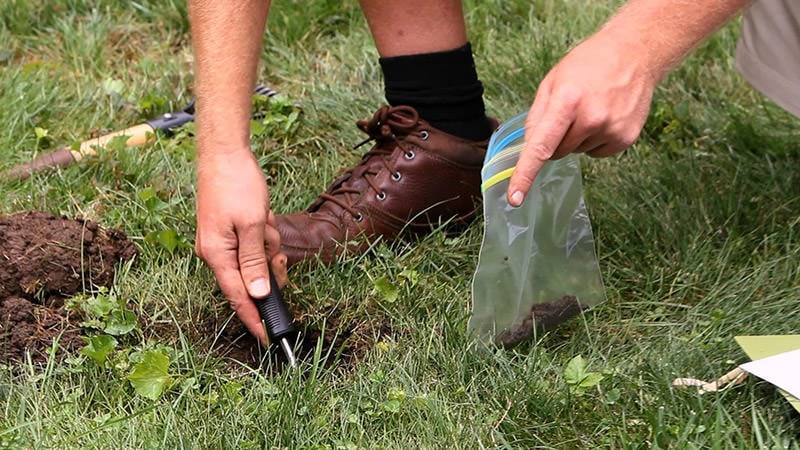
We take samples from across the playing surface and send them to a soil lab for pH, the major nutrients and the trace elements turf relies on. If the pH is out, the grass can't use what is already in the ground, so that gets corrected first. More on our soil testing service.
Choose the right mix
Depending on the results, that means slow-release granular fertiliser for steady feeding, mineral products for trace elements, faster nitrogen, phosphorus and potassium blends when the turf needs a lift, or a mix of these.
Spread it evenly
Uneven spreading shows up as light and dark stripes across a field. We work in measured, overlapping passes, keep fertiliser off paths, car parks and drains, and watch the forecast so a summer storm doesn't wash it off the surface.
Fertiliser timed around your season
Couch, the grass on most fields in South East Queensland, grows hard from spring to early autumn and slows right down when the soil cools. That is exactly when the winter codes are wearing it hardest, so timing matters as much as the product.
Recovery from wear
When the winter season wraps up, the field needs feeding alongside coring and top dressing, so worn goal mouths and centre corridors fill back in while the grass is growing fast.
Pre-season push
In late summer and early autumn we build density and cover ahead of the first fixtures, timed so the surface is thick and firm on game day rather than soft and lush.
Winter hardening
Heading into the cooler months, the program shifts to lighter nitrogen and more potassium, which helps the turf handle cold, wear and stress while growth slows.
Cricket outfields and summer sports run to a different calendar, so the program follows your fixture list. Our guide to sports field and school oval maintenance shows how feeding fits with the rest of the year's work.
What it costs, and what you get
What a fertiliser program costs
Jobs start from $220. What changes the price:
- The size of the playing area, and how many fields
- How many applications the season needs
- The products your soil test points to
- Travel to your ground
After the free onsite check you get a firm price for the soil test and the program. If the results call for extra work, such as lime to correct the pH, it is priced in writing before it goes ahead. Fertilising can also sit inside a year-round turf management program costed up front for your budget cycle.
Why work with us
- We test before we feed, and explain what the results mean for your field
- The program is laid out step by step in writing, ready for a club committee, school budget or council works program
- In-house Clegg hammer testing checks surface hardness alongside nutrition
- Our own crew and machinery, working around your fixtures
- Family-run and based in Beenleigh, covering fields up to 400 km away
From soil test to a stronger field
Free onsite check
We walk the field with you, check cover and wear, take Clegg hammer readings and talk through your fixtures, irrigation, past soil tests and budget.
Written program and price
You get a season-by-season feeding plan built around your fixtures, with a firm price for the soil test and the applications. Jobs start from $220.
Testing and application days
The lab results set the products and rates. Each feed is booked around games and training, watered in by irrigation or timed ahead of light rain, and we tell you when the field is ready to use.
Common questions
How much does a turf fertiliser program cost?
When should a sports field be fertilised?
How often should an oval be fertilised?
Do you need to test the soil first?
Can players use the field straight after fertilising?
Can fertilising be done at the same time as aeration or top dressing?
Book a free onsite check
We walk the field with you, take spot Clegg hammer readings, look at the soil profile, wear, drainage and thatch, and tell you whether a lab soil test is due. Then you get a clear plan and a price that fits your season and budget. No charge, no obligation.
- Jobs from $220
- Homes within 100 km of Beenleigh
- Sports fields across South East QLD and Northern NSW