
AFL and cricket oval line marking in Brisbane
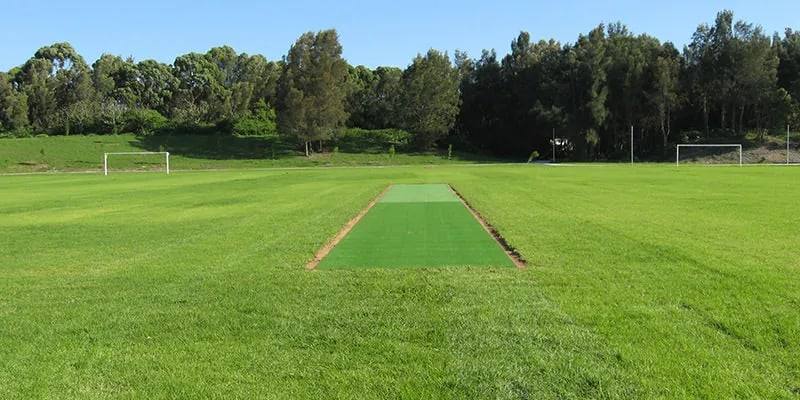
The cricket pitch is still in the middle of the ground, round one is getting closer and last season's centre square had wandered by finals. We set out AFL and cricket layouts with a GPS line marker, measured from your goals and pitch, and re-mark them in the same place through the season.
- Pre-season and seasonal marking, costed up front
- Our own GPS line marker for accurate set-out
- Our own crew, family-run in Beenleigh
- Fields up to 400 km from Beenleigh
Why an oval is harder to mark than a rectangle
A rectangular field is mostly straight lines. An oval is curves, arcs and circles, on a ground shaped differently to the one down the road. The centre has to sit halfway between the goals, the 50 m arcs are measured from each goal line, and the cricket circles from whichever pitch is in use, which isn't always dead centre. Get one reference point wrong and everything built from it is out too.
- The centre square and circle shift a little with every re-mark
- The 50 m arcs don't measure the same at both ends
- The boundary runs too close to the fence, coaches' boxes or light towers
- Lines have faded by the weekend because mowing got to them first
- Volunteers are spending weeknights with tape measures and string lines
- The cricket-to-football changeover runs right up to round one
First round coming and the oval still unmarked?
Tell us your first fixture date and which layouts you need. We'll measure the ground and give you a firm price per mark or for the whole season.
AFL and cricket layouts, set out properly
We take our reference points from your goals and the pitch, place each line with the GPS line marker and paint to the dimensions your code and competition use.
AFL in winter
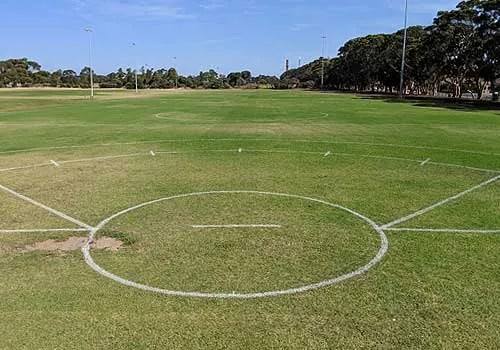
The boundary line, the 50 m centre square, the centre circle with its inner circle and dividing line, 50 m arcs measured from the centre of each goal line, and goal squares 6.4 m wide by 9 m deep. Interchange areas and any extra lines your league needs can be added.
Cricket in summer
A boundary line set to fit your ground, and the inner fielding circle: two 30-yard (27.43 m) semicircles centred on the middle stump at each end, joined by straight lines, painted solid or dotted as your competition prefers. Creases on a turf wicket are usually the curator's job, but we can talk it through.
Junior and shared grounds
Junior football and cricket use smaller layouts, and many school and council ovals carry more than one code. We mark to your association's modified dimensions and plan the layouts so each code's lines stay easy to read. Rectangular fields are covered on our football field line marking page.
Setting out by GPS rather than tape measure means round circles, arcs that match at both ends, and a layout that can be repeated at every re-mark instead of creeping week by week.
Getting the changeover right
Most South East Queensland ovals swap codes twice a year: cricket hands over to football around March and April, and football hands back after finals in August or September.
- We plan the changeover with both clubs and whoever manages the ground, around the last cricket fixture and the first football one
- The new layout is set out around the fading old lines so it reads clearly
- The AFL centre square sits over the wicket area, so we work around covers and wicket renovation
- If cricket finals overlap with football pre-season, we mark what each club needs
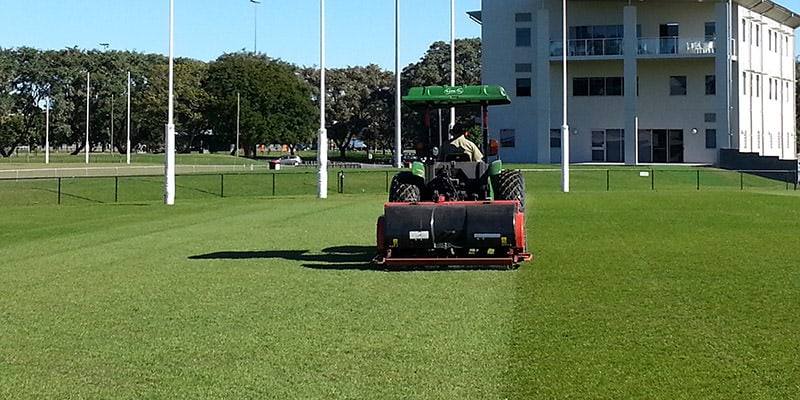
It's also a good time to look at the surface, while the couch is still growing well enough to recover. An oval coming off a long cricket season is often hard and worn, and a turf wicket block, rolled hard all summer, sits right where centre bounces are contested. A Clegg hammer test measures how hard the ground is, with the readings written up for your club or council, and the worst areas can be core aerated and top dressed before the new lines go down. Our guide to sports field and school oval maintenance covers the between-season work.
A clear price before the first line goes down
What changes the price
Jobs start from $220. From there, the price depends on:
- the size of the ground and how many layouts it needs
- a full set-out, or a re-mark of lines already there
- how often we come back through the season
- how far the oval is from Beenleigh
- any field work done on the same visit
After the free onsite check you get a firm price per mark, or one figure for the season, in writing for your committee, school or council. Here's how seasonal line marking contracts work.
Why All Grass Solutions
- We look at the ground before we price it
- Our own crew and GPS line marker
- We're turf people too: if lines won't hold because of scalping or wear, our sports field maintenance work can fix the cause
- Family-run, based in Beenleigh, marking ovals up to 400 km away
- February to April is our busiest period, so we'll be straight with you about which dates we can do
From first call to first bounce
Free onsite check
We walk the oval with you, find the centre, check the fence line, wicket and posts, and talk through your fixtures for both codes.
Clear plan and price
You get the layouts, a re-mark schedule and a firm price per mark or for the season. Jobs start from $220.
Marking day
Our crew sets out and paints the ground with the GPS line marker, then comes back on schedule to keep the lines sharp.
Common questions
How much does AFL or cricket oval line marking cost?
When should we book marking for the football season?
Do you mark to official AFL and cricket dimensions?
How long do the lines last?
Can you work around a turf cricket wicket?
Do you mark ovals outside Brisbane?
Book your oval's pre-season marking
Tell us about the ground, the codes that use it and your season dates. We'll come out, find the centre, check the fence line, wicket and posts, and give you a firm price per mark or for the season. No charge, no obligation.
- Jobs from $220
- Homes within 100 km of Beenleigh
- Sports fields across South East QLD and Northern NSW